



IDEA FLAKES
BETTER AND FASTER RESULTS.
IDEA FLAKES Innovation Cards provide you with valuable impulses for your ideation workshops, innovation or development projects. They are also suitable for product and service development, start-ups, new business models and problem-solving workshops. There are a range of possible applications to inspire teams or individuals.
The 130 Innovation Cards consist of an icon, a keyword and a statement or a key question
(2 alternative sets: English/German or English/English)
Choose the methods that suit you best and lead to good results quickly.
1. INITIAL IGNITION
The aim here is to get the teams thinking and initially break down inhibitions. This is achieved through rapid changes of perspective and unusual pattern interruptions.
- The participants are asked to formulate their own ideas one after the other based on a central task (challenge) and to visualize and share them with others via a POST-IT on the wall.
- Between each idea, the IDEA FLAKES are placed on the table one after the other. They inspire the participants to think in new directions and come up with new ideas, which are placed on the wall one after the other.
- The collected ideas are then structured and clustered using classification terms and headings. Finally, the team discusses the individual “fields of innovation” and embarks on a further search for ideas.
2. GALLERY WALK
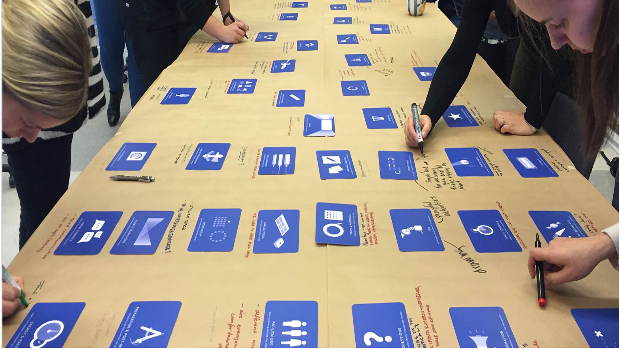
All 130 IDEA FLAKES are laid out on a long table, which is covered with sheets of paper in advance. The Gallery Walk is based on a common task that is formulated and agreed beforehand.
The participants walk past the table with a marker and read the Innovation Cards against the background of the task.
- Spontaneous ideas are then written directly next to the cards on the paper, resulting in a collection of initial ideas based on the impulses.
- The previous ideas always inspire other participants to come up with new ideas, which are then noted down.
3. INNOVATION GAME
The idea here is “innovation through combination”. The workshop participants sit at a table. There is a “secretary” who records the ideas on POST-ITs and sticks them on the wall for everyone to see.
- Round 1: The pile of innovation cards is placed in the middle of the table and the participants take it in turns to draw and reveal a card.
- Each impulse of the team to a certain card is noted by the secretary and placed visibly
- The ideas are then structured into topic areas and, if necessary, merged with other ideas (“mash-up”)
- Round 2: The team discusses the individual topics and ideas and develops further ideas that are added
- Round 3: Short concepts (one-pagers) are created for the best ideas, which capture the most important points: brief description of the idea, mechanics, benefits, etc.
4. WHAT IF
What if… The focus here is on a jointly formulated future scenario. For example: “What if our competitor were to offer a better and cheaper comparable product tomorrow?” Short-term solution strategies are sought.
- The team uncovers each innovation card in turn and decides whether there is a “springboard” for a solution.
- If yes, the idea is briefly noted on a POST-IT, if no, the next card is revealed
- Once all the cards have been viewed, the team evaluates and prioritizes the collected solution approaches, works them out more concretely and makes an implementation decision
5.INNOVATION SPRINT / DESIGN THINKING
After the joint formulation of the task (challenge), the innovation cards are used in the problem space to identify starting points for current core problems and to scrutinize them with the target groups/personas.
- Im Problemraum werden Nutzerbedürfnisse, Insights oder Barrieren aus den Karten abgeleitet. Das Team erkennt, welche Herausforderungen gelöst werden müssen.
- In the solution space, the Innovation Cards serve as a source of inspiration for new solutions and ideas
- Im Anschluss können auf dieser Basis Prototypen zur finalen Entscheidungsfindung entwickelt und getestet werden
6. DEEP DIVE WITH AI
Use the keywords on the innovation cards and the statements or key questions to obtain further suggestions via an AI application such as ChatGPT or Gemini. Also use the AI’s dialog options and queries to gain in-depth impetus and new insights in your individual application context. Incorporate the relevant aspects into your workshops and evaluate them together with the team.